





















Affidavits are among the most vital lawful tools used to validate realities, make clear disagreements, and assistance formal proceedings-both in courts and business operations. Yet for several, the concept of a testimony continues to be abstract or misunderstood. Whether you’re a private dealing with a family members matter, a company specialist confirming ownership, or a lawful team improving conformity, comprehending exactly how sworn statements work-and exactly how they can currently be digitized-is crucial.
Sworn statements are no longer restricted to paper-based styles signed in individual. Thanks to modern-day systems like Certinal eSign, affidavits can currently be drafted, authorized, and stored digitally, using rate, safety and security, and full legal legitimacy.
This overview breaks down what a testimony is, just how it’s made use of, and the numerous types of sworn statements relevant to both personal and company contexts.
What Is a Sworn statement?
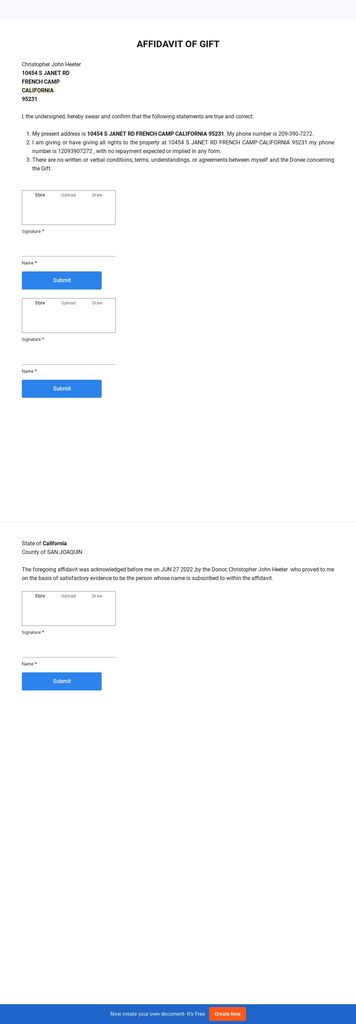
A testimony is a composed, vouched declaration of fact that is willingly made by an individual-known as the affiant-under oath.Read here Affidavit of Gift Transfer At our site This declaration is validated by a legal authority such as a notary public or a commissioner of vows, that verifies the identity of the endorser and the truthfulness of the declaration.
The term ‘affidavit’ originates from Latin, implying ‘he has actually stated upon vow.’ At its core, it is made use of to officially mention facts in composing that the affiant is willing to attest in a court of law or main procedure. Once notarized or vowed, the testimony becomes lawfully binding and acceptable in legal proceedings.
A testimony usually includes:
- The complete name and information of the affiant
- A clear and concise statement of realities
- The day and location of implementation
- The affiant’s trademark
- A notary or official certification
Testimonies are frequently made use of in legal settings however are increasingly called for in economic, immigration, and federal government paperwork operations. Their purpose is to attest that certain information holds true, and the affiant comprehends that false declarations can lead to penalties-typically fees of perjury.
Common Use Cases for Sworn Statements
Sworn statements are exceptionally versatile and are utilized across several markets and legal domains. Below are several of the most common circumstances where testimonies play a crucial duty:
1. Legal Procedures
Affidavits are frequently submitted as proof in litigation, specifically during the initial phases. For example, a witness could give an affidavit recounting events rather than testifying personally. This is often done to simplify proceedings or give assistance for motions and filings.
2. Company and Corporate Purchases
In organization contexts, sworn statements might be used to accredit the identity of investors, affirm the accuracy of economic declarations, or validate the execution of particular actions-such as board resolutions or agreement terms. They’re especially beneficial in compliance-heavy fields like insurance coverage, banking, and procurement.
3. Property and Building Administration
Customers and vendors usually use sworn statements to state the legal ownership of a building, validate there are no exceptional liens, or state the absence of beneficiaries. These files help secure against future conflicts and supply official affirmations throughout title transfers.
4. Migration and Government Applications
Affidavits are often needed to confirm identity, connection, or support-particularly in immigration situations. For example, a testimony of assistance is made use of to ensure economic obligation for a visa applicant.
5. Individual Affirmations
Sworn statements can likewise be made use of in individual issues, such as:
- Confirming a change of name
- Proclaiming residency
- Stating marriage or parental status
In all of these usage instances, affidavits function as legal alternates for real-time statement or confirmation, making them highly efficient devices in scenarios where in-person recognition isn’t sensible or needed.
Sorts of Affidavits
There is no solitary ‘universal’ sworn statement. Rather, affidavits are adjusted to the lawful, financial, or step-by-step requirements of the moment. Right here are some of one of the most frequently made use of types:
1. Testimony of Residence
This is utilized to develop the residence of a departed individual, particularly in cases involving the transfer of possessions, probate, or estate issues. It’s typically required by banks or courts to refine possession claims.
2. Financial Sworn statement
A monetary testimony information an individual’s revenue, costs, assets, and liabilities. It is typically made use of in divorce proceedings, lending applications, and personal bankruptcy filings. Precision is vital, as any kind of misinformation can cause severe legal effects.
3. Testimony of Heirship
This testimony is utilized when a person passes away intestate (without a will), and their legal heirs need to be recognized for inheritance or estate administration objectives. It generally consists of information regarding the household structure and partnership to the deceased.
4. Sworn statement of Service
Mostly made use of in lawful procedures, this testimony is submitted by a process-server or lawful rep to confirm that a legal document-such as a subpoena or summons-was successfully delivered to the relevant party.
5. Testimony of Assistance
Common in migration and visa applications, this affidavit validates that a U.S.-based enroller has actually agreed to financially support the visa applicant and stop them from becoming a public charge.
6. Affidavit of Identity or Name Adjustment
Made use of to make clear identification inconsistencies as a result of name modifications, misspellings, or lawful identification updates, specifically when matching records throughout establishments.
Each of these sworn statements adheres to a similar framework however varies in material based upon its intended lawful or administrative function.
Lawful Effects of Testimonies
A sworn statement isn’t simply a created statement. It is a legitimately binding statement of fact, lugging the same weight as spoken testament in a law court. As a result of this, testimonies come with significant legal consequences if misused or falsified.
1. Danger of Perjury
As soon as authorized and notarized, a sworn statement comes to be a promised declaration. That means any false info purposefully consisted of in the paper can cause perjury charges-a crime in most territories. Depending on the legal system, perjury related to a sworn statement can result in fines, imprisonment, or civil fines.
This is why testimonies typically consist of a jurat or vow, specifying that the affiant recognizes the effects of lying under oath and attests that all statements are exact to the best of their knowledge.
2. Lawful Admissibility
Courts throughout territories approve testimonies as legitimate kinds of proof, specifically throughout pre-trial movements, civil litigation, or administrative reviews. However, for an affidavit to be acceptable, it needs to be:
- Carried out willingly
- Authorized by the affiant
- Licensed by a legal authority such as a notary public or commissioner of vows
- Free from threat or uncertainty
Improperly formatted or anonymous sworn statements are likely to be turned down by the court, which is why electronic platforms that apply organized implementation and auditability are increasingly essential.
3. Administrative Needs
Each country-and commonly each state or province-has different rules around sworn statement validity. Some require wet ink trademarks and in-person registration; others now approve electronic signatures and remote notarization under details laws (like ESIGN Act in the united state or eIDAS in the EU).
Falling short to comply with regional legislations can render an affidavit void, particularly in cross-border business or lawful issues.
The Digital Transformation of Sworn Statements
The affidavit-historically a paper-heavy, in-person document-is undertaking a digital transformation. Driven by the requirement for speed, ease of access, and regulative dexterity, lawful and business specialists are accepting digital sworn statement operations.
1. Remote Online Registration (RON)
Remote Online Registration enables affiants and notaries to complete affidavit implementation over safe video clip conferencing devices. It includes:
- Identification verification through government-issued ID
- Live audiovisual recording of the finalizing
- Digital journaling and electronic certificates
RON is particularly valuable in jurisdictions where in-person notarization is inconvenient, such as throughout global travel constraints or for cross-border record implementation.
2. Electronic Signatures and Digital Identification
Sworn statements signed electronically making use of lawfully recognized eSign platforms are now approved in lots of courts and regulatory procedures. A valid digital trademark, when paired with identity confirmation and timestamping, holds the very same legal weight as a handwritten one in the majority of areas.
This not only lowers physical documents but additionally assists make sure precision and integrity-since digital trademarks can not be backdated, modified, or shed in transit.
3. Centralized Document Storage Space and Retrieval
Rather than relying on physical declaring closets or regional drives, electronic testimonies can be firmly kept in encrypted cloud systems with role-based accessibility and audit trails. This is necessary for:
- Regulatory audits
- Inner compliance checks
- Evidence collection in lawful procedures
It also makes it possible for legal teams to get any sworn statement instantly-no scanning, no carrier delays, no file version confusion.
Just how Certinal eSign Helps with Testimony Processes
Certinal eSign is purpose-built to fulfill the one-of-a-kind challenges of implementing and taking care of lawful records like sworn statements. Unlike generic eSignature tools, Certinal takes a workflow-native, compliance-first strategy that straightens with market regulations and the operational complexity of legal and enterprise utilize cases.
Below’s exactly how Certinal changes testimony operations:
1. Pre-Configured Design Templates and WebForms
Certinal allows legal and procedures groups to develop sworn statement themes that are multiple-use, standardized, and legally structured. Integrated WebForms ensure affiants input needed information without formatting issues or missing out on areas.
For example, a financial affidavit kind may auto-calculate total obligations based on individual inputs-eliminating human mistake.
2. Role-Based Routing and Conditional Logic
In many sworn statement procedures, several signers or customers are included. Certinal’s process engine allows routing to:
- Affiants for statement input
- Lawful reviewers for authorization
- Notaries for final implementation
This lowers delays, tracks SLAs, and makes sure compliance checks are applied in real time.
3. Safeguard, Compliant eSignature and Registration
Certinal sustains lawfully acknowledged electronic trademarks, and is compliant with:
- ESIGN and UETA in the united state
- eIDAS in the EU
- Local guidelines throughout APAC and MENA
For notarized affidavits, Certinal incorporates with Remote Online Notarization suppliers to embed notary operations into a single seamless procedure.
4. End-to-End Audit Trails
Every affidavit implemented with Certinal is backed by a tamper-proof audit trail that logs:
- Each viewer or editor
- Every trademark timestamp
- Identification verification steps
- Adjustments made and by whom
This develops a secure, court-defensible chain of protection.
5. Centralized Control Panel for Conformity Teams
Legal, danger, and conformity teams can check out the sworn statement lifecycle throughout departments or jurisdictions in real time. Control panels show in-progress sworn statements, pending notary activities, or upcoming SLA breaches-enabling proactive administration.
Verdict
Affidavits are more than formal declarations-they are foundational to legal, monetary, and governing operations. From confirming identity to resolving estates or processing claims, these vowed statements lug serious lawful weight and call for careful implementation.
In the past, testimonies were taxing, paper-driven, and prone to mistake. But with the surge of digital sworn statement workflows, insurance firms, banks, and legal teams can now automate the entire lifecycle-from composing to notarization-without compromising compliance or safety and security.
Certinal eSign encourages organizations to produce, sign, and track sworn statements with confidence-combining WebForms, intelligent routing, remote registration, and complete audit trails in one protected platform.
Whether you’re digitizing lawful procedures, enhancing client onboarding, or guaranteeing regulatory readiness, Certinal aids you turn sworn statements from a traffic jam right into a streamlined, strategic property.